Replacing a worn or damaged tire and wheel can help restore the performance of your wheelbarrow, hand truck, wagon, or zero turn mower. Flat-free tire and wheel assemblies are also convenient because they do not require air inflation.
Before installation, make sure the replacement wheel matches your equipment's tire size, axle diameter, bearing size, and hub length.
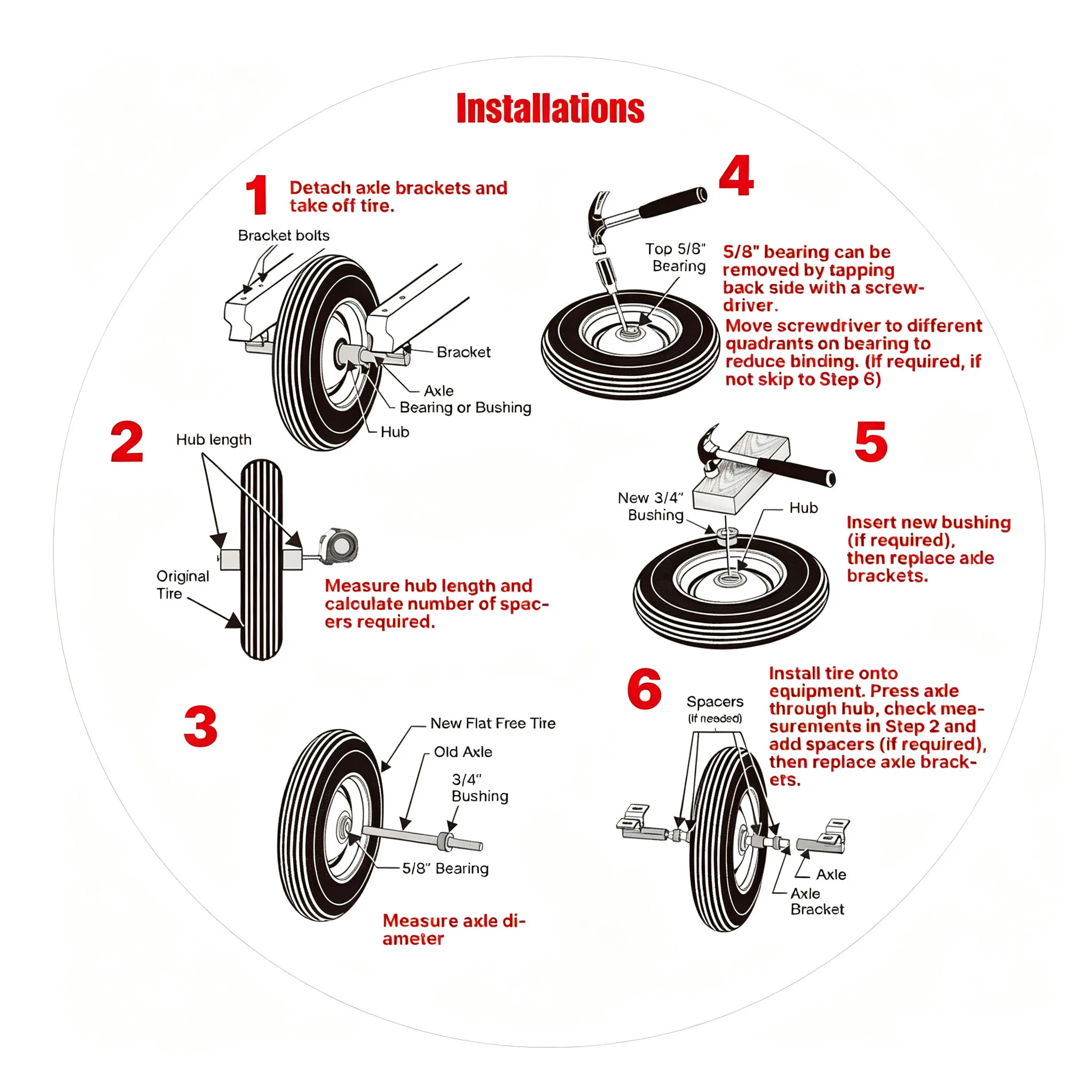
Step 1: Remove the Old Wheel
Secure the equipment on a stable surface. Remove the axle brackets or retaining hardware, then slide the axle out and remove the old tire and wheel assembly.
Keep the axle and hardware nearby because they will be reused during installation.
Step 2: Measure the Hub Length
Measure the hub length of the original wheel and compare it with the replacement wheel.
If the hub is too narrow for the space between the axle brackets, spacers can be added to achieve the proper fit.
Step 3: Check the Axle Diameter
Measure the diameter of the existing axle and make sure it matches the bearing size of the replacement wheel.
The bearing inside the new wheel must match the axle diameter. Depending on the application, flat-free replacement wheels may use 1/2", 5/8", or 3/4" bearings.
For example, mower and garden tractor wheels may use 1/2" or 5/8" bearings, while some wheelbarrow and hand truck wheels use 3/4" bearings.
Step 4: Remove the Old Bearing
If the old bearing needs to be replaced, carefully remove it using an appropriate tool. Work around different points of the bearing rather than applying force to only one side.
Clean the hub area before installing the new bearing.
Step 5: Install the New Bearing and Spacers
Install the correct bearing or bushing into the wheel hub. Then add the required spacers according to the hub length measured earlier.
Make sure the bearing is seated properly and the spacers are positioned correctly.
Step 6: Install the New Flat-Free Wheel
Place the new wheel between the axle brackets and slide the axle through the bearing and hub.
Check the alignment and make sure the wheel is centered. Add or adjust spacers if necessary, then reinstall and secure the axle brackets.
After tightening the hardware, rotate the wheel by hand. It should turn smoothly without rubbing, binding, or excessive side-to-side movement.
Flat-Free Tire and Wheel Replacement Options
Different types of equipment require different tire sizes, bearing sizes, and hub dimensions. Always check your original wheel measurements before ordering.
For Wheelbarrows, Hand Trucks and Wagons
Our 2pcs 15" 4.80/4.00x8 Flat-Free Tire and Wheel Set features a centered hub with a 3"–7.2" hub range and 3/4" bearings, making it suitable for compatible wheelbarrows, hand trucks, wagons, and other utility equipment.
For Zero Turn Mowers
Our 2pcs 11x4x5 Flat-Free Tire and Wheel Set features a 3.4"–5.98" centered hub and is available with 1/2" or 5/8" bearings for compatible zero turn mowers.
For Lawn Mowers and Garden Tractors
We also offer several flat-free tire and wheel sizes for compatible lawn mowers and garden tractors, including 11x6x5, 13x5x6, 9x3.50x4, 13x4.00x6 and other configurations with different hub and bearing sizes.
Before purchasing, compare the tire size, hub length, axle diameter, and bearing size with your original wheel.
Final Installation Check
After installation, check the following before using the equipment:
· The bearing matches the axle diameter.
· The hub is properly centered.
· Spacers are correctly positioned.
· The axle and retaining hardware are secure.
· The wheel rotates freely without rubbing.
Taking a few minutes to check these measurements and connections can help ensure a proper fit and smooth operation of your new flat-free tire and wheel.